
ADA signage in Corona isn't just a legal necessity; it's a commitment to inclusivity, enhancing accessibility for all customers and protecting your business from costly non-compliance issues in California.
In Corona, California, operating a business means navigating a unique blend of local charm and stringent regulations. Among the most critical, yet often misunderstood, are the requirements surrounding ADA signage. The Americans with Disabilities Act (ADA) is a federal civil rights law that ensures people with disabilities have equal access to public accommodations and commercial facilities. However, California, through its Building Standards Code (Title 24) and other state laws, often goes a step further, imposing even stricter and more detailed requirements. For businesses in Corona, this means ADA signage Corona is not just about ticking a box; it's about making your space genuinely accessible, welcoming all patrons, and, crucially, safeguarding your business from potential lawsuits and penalties.
The Two Pillars: Federal ADA and California's Title 24
When we talk about ADA signage in Corona, we're primarily referring to two interconnected sets of guidelines:
The Americans with Disabilities Act (ADA) Standards for Accessible Design: These are federal guidelines that dictate broad requirements for accessible signage across the U.S. They cover aspects like:
Tactile Characters: Raised letters (1/32" high, uppercase, sans-serif, 5/8" to 2" height).
Braille: Grade 2 Braille accompanying tactile text.
Non-Glare Finish: Signs must have a matte or non-glossy surface.
High Contrast: Strong visual contrast between characters and background.
Mounting Height and Location: Specific ranges (e.g., 48-60 inches from the floor for tactile signs, on the latch side of the door).
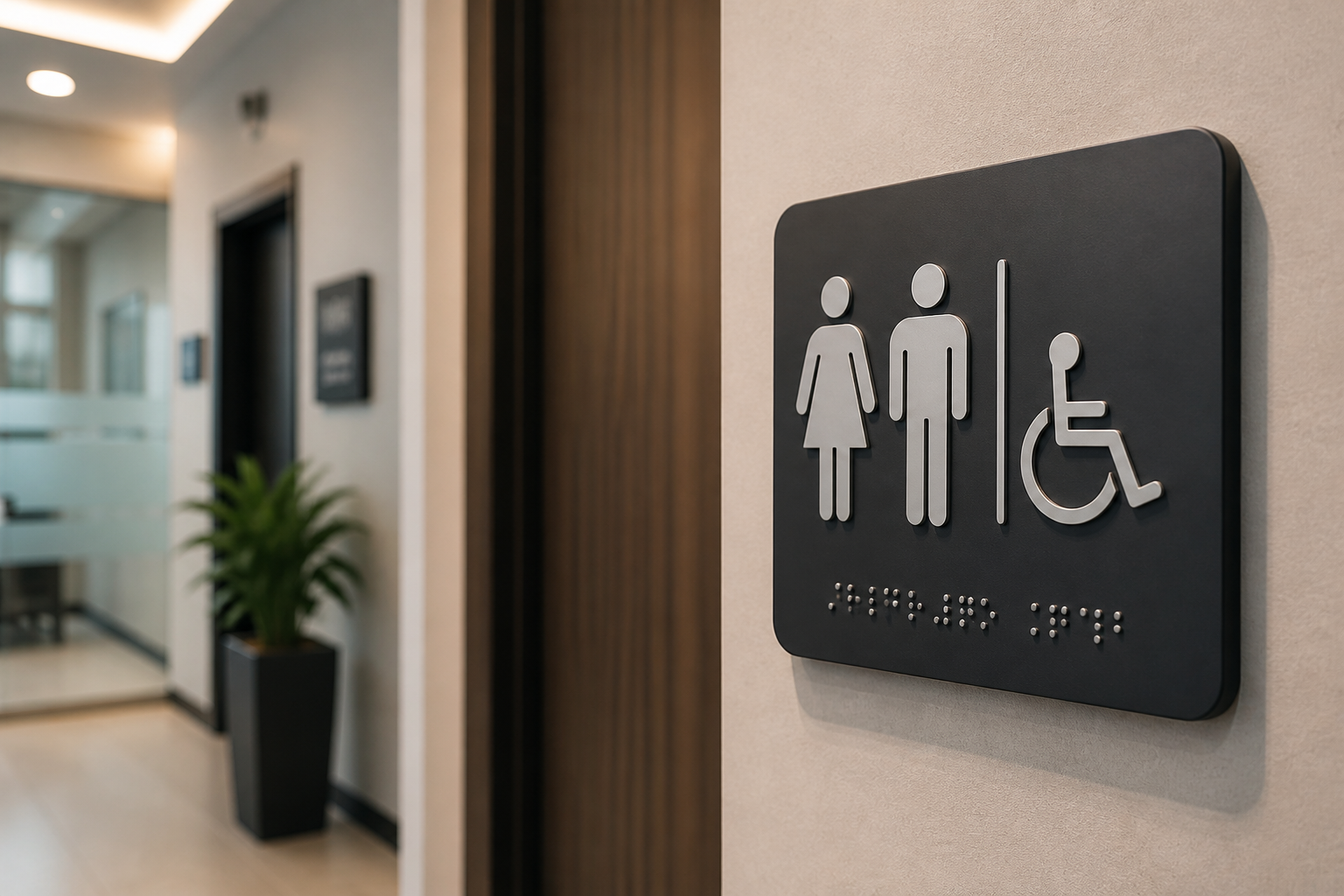
Pictograms: Universal symbols for accessibility, restrooms, etc., with accompanying tactile text/Braille.
California Building Standards Code (Title 24): California's regulations often add layers of detail and specificity, particularly in areas like restroom signage and Braille standards. For businesses in Corona, Title 24 is paramount. Key California distinctions include:
California Braille: Specific dot height and spacing requirements that are unique to California.
Dual Restroom Signage: This is a major one for California. In addition to the standard ADA tactile wall sign, California requires a geometric door sign mounted directly on the restroom door (12-inch triangle for men, 12-inch circle for women, and a triangle superimposed on a circle for gender-neutral/unisex restrooms). These geometric signs also have specific thickness and contrast requirements.
AB 1732 (Equal Restroom Access Act): Specifically requires single-occupancy restrooms to be gender-neutral with the corresponding geometric door sign (triangle on circle).
Where is ADA Signage Required in Corona?
Generally, ADA signage in Corona is required for any permanent room or space within a public accommodation or commercial facility. This includes, but is not limited to:
Restrooms: Perhaps the most commonly cited area, requiring both wall-mounted tactile/Braille signs and the unique California geometric door signs.
Room Identification: Offices, conference rooms, classrooms, utility rooms, storage closets, etc., that are designated for permanent use.
Exit & Egress: Exit signs, exit stairways, areas of refuge.
Accessible Features: Signs identifying accessible entrances, exits, parking spaces, elevators, drinking fountains, and telephones.
Directional Signage: Certain directional signs that lead to permanent rooms or accessible features.
It's important to note that temporary signs, changeable directories, and menus (unless they identify a permanent room) are generally exempt from tactile and Braille requirements, but still often need to meet visual accessibility standards (contrast, non-glare).
The Business Case for ADA Compliance in Corona
Beyond the legal mandate, embracing ADA signage in Corona offers significant advantages for your business:
Avoid Costly Litigation: California has a reputation for active enforcement and a high number of accessibility-related lawsuits. Non-compliance can result in substantial fines, legal fees, and forced modifications, which can be far more expensive than proactive compliance. A "CASp" (Certified Access Specialist) inspection can provide a clear path to compliance and offer "qualified defendant" status in certain lawsuits.
Expand Your Customer Base: By making your facility truly accessible, you open your doors to a wider demographic, including individuals with disabilities, their families, and friends. This translates directly to increased patronage and revenue.
Enhance Brand Reputation: Businesses that prioritize accessibility are viewed as responsible, inclusive, and community-minded. This positive brand image can differentiate you from competitors and foster customer loyalty.
Improved User Experience for All: Clear, well-designed ADA signs benefit everyone. Easy-to-read fonts, high contrast, and logical placement improve navigation for customers with low vision, those unfamiliar with your layout, and even those simply in a hurry.
Operational Efficiency: When customers can easily find restrooms, offices, or exits, it reduces the need for staff to provide directions, freeing them to focus on core services.
Navigating Compliance in Corona: The Role of Professionals
The nuances of federal ADA guidelines combined with California's Title 24 (and any specific City of Corona building code overlays) can be complex. For businesses in Corona, partnering with an experienced sign company that specializes in ADA compliance is not just helpful, it's essential. A knowledgeable sign provider will:
Stay Up-to-Date: Continuously monitor changes in federal and California state regulations.
Conduct Site Surveys: Assess your specific location and identify all areas requiring ADA signage.
Design & Fabricate Compliant Signs: Ensure all signs meet precise requirements for raised characters, Braille (California standard), finish, contrast, pictograms, and aesthetics.
Handle Permitting: Assist with any local permitting requirements from the City of Corona's Planning or Building Department.
Ensure Correct Installation: Install signs at the exact mandated heights and locations to ensure full compliance.
Conclusion
For any business in Corona, ADA signage is more than a legal obligation; it's an opportunity to demonstrate your commitment to inclusivity, enhance customer experience, and protect your long-term viability. By understanding the interplay of federal and California state laws and leveraging the expertise of a professional sign company, you can ensure your business is not only compliant but also welcoming and accessible to every individual who walks through your doors. Make accessibility a cornerstone of your business strategy in Corona, and reap the rewards of a truly inclusive environment.



Write a comment ...